
Poor Patrick
The teacher moved around her classroom, feeling the angst of simultaneous emotions that contradicted each other. She was proud of having started the year with her Grade 3 class with many new and innovative programs. At the same time, she was acutely aware that, although the students seemed busy and engaged, there was at least one quarter of the class who struggled each day to keep up with the demands of Grade 3 work. She knew when the children in came in from recess that the lesson she had prepared was going to be the most challenging part of her day. However, she handed out the pages and straightened their chairs, so the children would be organized for Science.
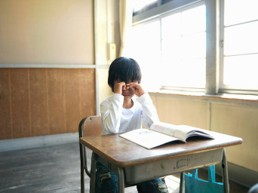
The bell rang, and the next five minutes were filled with the chaos that accompanies 8-year-olds who cannot find their shoes, fail to hang up their coats, and poke each other while they yell at the tops of their lungs in order to be heard. After the final few rustles, comments and chair scrapings, Ms. Hood instructed the children to read the pages that she had just handed out. Patrick, a slim, sweet-faced boy, looked at the page and groaned out loud.
“Patrick, it’s only one paragraph. It won’t take you long if you concentrate.” Ms Hood always tried to stay cheerful when talking to Patrick, as he was so easily discouraged. Patrick obeyed and took up the page and began to ‘read’ what he saw.
Mxxxtxxn lxxn is a tarye axxxal of the cat faxxlg. Mxxxtxin txxxs xnxe kxvxt th xxxgxxxt the hxrxslx of the Uxxkeb Slxxtxs nd Bxxtixh Cxlxxbix. When sxtkhxrs mxvxb in, they brxvx this axxxal out. The mxnder of nxxxtxxn kxxns has been yrxxtlp rebxxed in bxlh these coxxtrxxs, exxxgt in lxrpx nxlxxnxland stlxlx or groxxnxxxl qxrts. Tobag, mxxxtxxn txxns txvx stxxflp in weslxxn grxuxmces and slakes from Prxkxch Cxlxndxa and Aldxxta to Calxtxxnxa and Nxx Mexxxxo.
After three minutes, Ms Hood looked into the faces of most of the children who had finished and said, “Isn’t that interesting? Now children, I want you to write two sentences about mountain lions from what you read.”
Patrick looked at the page again. “This is about mountain lions? Cool!” he thought. He tried once again to decipher what was on the page so he could do what the teacher asked. But the more he tried, the worse the letters blended in front of his eyes. Soon, there was nothing there but a series of designs, almost pretty in their arrangement, but totally useless to give him any information. He felt the looming presence of his teacher beside him.
“Patrick, you haven’t started writing yet. Time’s almost up.”
Ms. Hood was patient, knowing Patrick took longer to process things, but it was just the same as last time. She knew he would not have the assignment started when most of the others were done, so she tried to help.
“Patrick, where do mountain lions live?”
“In the mountains?” he quipped. There was a little chuckle from the class and Patrick was relieved. He giggled too.
“Class, keep on writing. Actually, Patrick, I mean what countries do they live in? See, it says right here.” She patiently pointed to the words on the page that were supposed to tell him.
“Um, Africa?” He remembered that lions live in Africa, so it was a good guess.
“No, Patrick, read right here, it says ‘British…'”
“Columbia!” shouted Patrick. He looked hopefully at the teacher and was rewarded with a big grin. He grinned too. It was so seldom that he got an answer right the first time.
“Right, Patrick. Now write that down in a sentence.” There was a hopeful note in her voice. Maybe, just maybe, the lights were going on. Maybe he was finally ‘kicking in’ and reading would begin to flow for him. She had learned in teacher’s college that eventually everyone, even the slow starters, would eventually get this reading thing. After they had been exposed long enough and often enough to the same sounds, letters, and words, and after they had seen the words and letters written and heard them repeated out loud often enough, understanding would arrive, and reading would start. Patrick had had as much exposure to the written word and to the readers with the bright pictures as all the other students, but he had not been successful until now. But this could be the breakthrough day. Maybe understanding had arrived!
Ms. Hood hurried off to check on the other students and to give Patrick time to formulate his sentence. But soon, instead of the sound of busy pencil scratching paper, she heard the unmistakable sound of wadded paper thwacking the wall. Patrick had suddenly turned class clown and was entertaining the class with well-aimed spitballs. Her new-found hope thudded to the floor with the spit balls.
“Patrick, I told you to write that sentence. Where’s your paper?” Of course, she knew that it had been flying in wads across the room, and once again, she disappointedly sent him off to the principal’s office.
After school, Ms Hood cleaned up around the room, picking up pencils, wadded paper, and, of course, the dried spit balls. She just didn’t understand why so many in her class struggled to become readers. At teacher’s college, the professor was adamant that children were just natural readers. Just like they had learned to speak through exposure to the sounds and words of those around them, children would naturally begin to read the words on the pages because others around them could. They would be curious enough to want to learn what the shapes on the page mean. They would be able to guess the words from the pictures supplied in all the early readers. There were some who did learn. They had come into her class knowing the alphabet and the sounds they made. But some of the parents had been too lazy to teach their kids before kindergarten, and now, here she was, stuck with at least one-third of her class struggling to stay in their seats all day while she tried to get them to understand what was on the pages in front of them. Now, she was thinking that Patrick, like so many others she had tried to teach, would need a diagnosis and an Individual Education Plan. It was always a difficult decision, becasue it was so much extra work for her, and the students did not improve, they just had to do different and less work. Oh, why had she thought teaching would be fun?
Undoubtedly, our fictional Ms. Hood is at a loss as to how to help Patrick, or the others in the class who suffer in silence and struggle to do the basic task of reading. She has provided Patrick and the others with help in the remedial reading program available at the school, but nothing has helped. No one knows what to do with ” poor Patrick”. He can’t read, so he acts out in class.
Elementary teachers are probably familiar with at least one Patrick. It has become an all-too-familiar scenario, with no solutions. Why can’t he read? He’ s been through all the tests for motor skills, eye problems, and has had tests to determine ADHD possibilities. All are negative. When they do flash cards for sight words, he’ s got them, but he can’ t read a passage of text with understanding. Reading aloud is out of the question, because it’ s too painful. He began remedial reading last year to give him more practice and to reinforce the classroom teaching, but nothing has really improved.
Patrick is a composite of many children I have met who hate and avoid reading. All display similar symptoms: the endings of words are ignored; prefixes and suffixes have no particular meanings; there is no sounding out of words because the skill is not there; unfamiliar words are not pronounceable because no one has taught them that word. How do they get by? They bluff and pretend or resort to, “I just don’t feel good.” They become the class clowns or retreat into the attitude that they are simply stupid. I have had many an eighth-grade boy say that to me when I asked him why he needs tutoring. The most heartbreaking ones are diagnosed as ADHD and take Ritalin. (See https://www.macleans.ca/ society/health/is-adha-a-mental-health-crisis-or-a-cultural-one/.)
How did they get to this state?
The debate over how to teach reading has raged now for over fifty years. It is called the phonics approach versus the whole language approach, or some want to call it a difference over the definitions of reading. Modernists want children to understand the words, not just sound them out, adding that the student’s knowledge of the world will help the student ” to get meaning from text”. Proponents of phonics want to stick with traditional methods of teaching sounds attached to letters to get the sound of the word working to decipher the word and therefore the text. Rhetoric has been attached to both arguments and in the muddle, too many new readers are lost.
Whole language proponents say they have faith in children as learners: children, they say, grasp the letter /sound relationships with relatively little direct instruction. Specific phonics instruction is an add-on, not a first step in the process of learning to read. However, as I noted in the children having difficulties, the lack of specific instruction was showing. They could not read fluently and were ‘ phonemically handicapped’. It seemed unfair to expect them to work so hard to read words that, if they had the tools, they could figure out. Many children, up to sixty percent they say, will learn to figure the phonetic system out, or will memorize the shapes of new words quickly. But some, obviously over one in three, will suffer for lack of phonics forever.
What is phonics for?
English is a phonetic language. The letters of the alphabet make it so, unlike Chinese, which uses a system of pictures to represent whole thoughts. It is necessary to learn the specific use for either the letters or the symbols to be able to read in that language. The alphabet is the mechanics of the language, the particular way the English language developed from symbols into letters into words. Mechanics always comes before understanding and a child’s limited knowledge of what a text might mean cannot be a sound basis for learning to read. Like the incomprehensible paragraph above, words that use incomprehensible letters are not decodable, and will just be so many marks on a page. If the child learns how to decipher a word first, he will have a basis on which to put the understanding of that word. He will be able to look it up in dictionary, and will better be able to spell it, because the letters make sense. Eventually, as he sees it more and more, it will become one in his bank of known words that will make a text understandable. This is where the whole language takes over. We cannot ignore that students have to learn to put words into a context to pull out understanding. As I said, mechanics first, understanding following.
Whole Language is Not Logical
The best description of the whole language approach I have read is: ” … Learning to read involves developing strategies for making sense of text, and this in turn means developing letter/sound knowledge and the ability to use it along with context and prior knowledge, in order to think ahead and to use “fix it” strategies, as needed. While this sounds perfectly logical to someone who can read, it is not a logical progression of learning. One does not get anywhere close to “developing strategies for making sense of text” without first being able to decipher the text. One cannot discover the “letter/sound knowledge and the ability to use it” without explicit, direct instruction. If I ask you want sound this symbol makes, ∑ , you would not be able to tell me unless you know some Greek. Someone would have to tell you. Your ability to use that sound-symbol correspondence is limited by your learning that correspondence. Then attaching your “context and prior knowledge” to an undecipherable text is paramount to asking a child to run a vehicle without any prior instruction. Observation is not a substitute for learning and explanation. Finally, on what will the learning child base his need to “think ahead and to use “fix it” strategies, as needed”? How does one self-correct when one does not even know he has made an error?
Conclusion
Don’t get fooled into thinking that everything will turn out all right and the budding reader will eventually kick in when he has been exposed to enough words. I have met far, far too many poor readers and non-readers who have been victims of this whole language methodology. This is a national emergency and no one is addressing the need except by diagnosing a record number of learning disabilities and behaviour disorders. These diagnoses are simply cover-ups for the system’s failure to see the real writing on the wall. Whole Language theory implementation has been a catastrophic failure.