
The Elephant in the Classroom
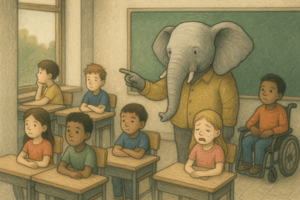
It’s supposed to be an understanding among teachers, something we tolerate because we have to. But truly we wish we could talk about it to relieve the pressure and make changes. It’s known by its euphemistic name, Diversity.
Diversity. If you have been involved in education for any length of time, you have heard the word, learned about its import and necessity, heard its tenets preached in every Pro-D presentation, and watched glowing video reports of its effectiveness as an integrative tool for the classroom. The ideals are lofty and commendable: allow everyone the right to be who they are as individuals, and make room for the multiplicity of personalities, likes and dislikes, learning styles, and learning preferences. In addition, verbal and non-verbal, walking and wheelchair-bound, readers and non-readers, and placid or disruptive students all must have their needs met in the diverse, inclusive classroom.
Diversity is touted as the great leveler. It will allow all people to live together in harmony. It will improve the world and do away with wars. Understanding everyone’s diverse needs will bring utopia. Really? While I am not against diversity, I also can see that in practical application, it does have limits. Diversity is useful on a team. Everyone has gifts and skills that can complement each other on a team, and a wise team leader will know how to choose appropriate team members to get something done. Diversity is welcome in society where everyone should be valued for their personhood just because they are alive.
Society should provide accommodations for the diversity of disabilities, whether they be physical or mental. We must be tolerant of religious views and sexual orientations. In the day-to-day world where we rub shoulders in the grocery stores, in the parks, on the beaches, and in stadiums, these tolerations and accommodations are easily put into practice. People can even monitor each other’s behaviour to make sure we respect each other’s rights to health and fairness. But in a classroom, where children are forced together into groups that are supposed to be accomplishing one task together in a time-limited way, the idealism is quickly overcome by a chaos of diverse needs and desires.
Let’s look at a typical lesson in Language Arts in a Grade 3/4 class. The teacher has created a lesson around a book. It is at the Grade 3 reading level, chosen for this class based on the likes of many students. As she hands out copies, there are audible groans from some. Whispers, not quiet whispers, start from a few places. “Not whales again!” “Ms. Parson, I have to go pee.” “I hate LA class.” The EA that was supposed to be there is being held up in the hallway with one of the students who refuses to return to class after the break. Ms. Parsons calls for quiet, and the students gradually take their seats and look at her.
At last, it is quiet enough to proceed. In order to get the non-readers to understand the lesson, Ms. Parson must read the story aloud. She was taught that when listening to a story and understanding it, students are just as literate as those who can read it. She also knows that the students who read are succeeding in school and those who can’t read struggle. In any event, she reads the story aloud. It takes longer than the allotted 10 minutes. The EA has returned during the reading with the recalcitrant student, which disrupts the class for two minutes. Two students have raised their hands to ask her to repeat what she has read. Patrick suddenly needs to go to the bathroom, and as he is in a wheelchair, his physical needs must be attended to in a timely way. So the EA takes him out and Ms. Parsons waits while he leaves. Another two minutes has elapsed. She resumes the lesson, but now she must bring the class back to order, as many students have drifted into other thoughts or started to whisper to their classmates. One boy has even got up to retrieve the reading because he had wadded it up and thrown it across the room.
She finally gets the reading done with few more disruptions, but she has noticed that some were not really paying attention. She knows that some will not have heard all the story, but she must proceed. So she asks questions that are intended to elicit the understanding required for it to be a proper Grade 3 LA lesson. As usual, she must repeat the question a few times, rephrasing it so all will understand. She waits as a few think about the answer and the rest wait for someone else to answer so they do not have to risk being wrong. There is finally an answer and a short discussion, and they agree on an answer. Ok, that part has gone well, as it is typical of any LA class. She does not expect the non-readers to answer, but one student who loves to listen has answered well. She relishes these small victories. This process is repeated as Ms. Parsons goes through the various levels of questions required for true comprehension. The answers come from fewer and fewer students, and some are already getting restless and bored because they cannot follow the conversation. It has been 35 minutes, and there are 10 minutes left to elicit some kind of activity to reinforce their learning. This lesson is designed to elicit how well students are comprehending story content, so she was hoping to get a short story synopsis from them, but she knows many, too many, will not be able to do that.
Ms. Parsons hands out the pages for the activity. The students are asked to write a few sentences about what they learned. Their sheet has the typical Who, What, When, Where, and Why headings to provide some structure for their reflection on the story. Now she faces another challenge. There are five students in the class who do not write their own work down. One is labeled as incapable of writing because of ADHD, one has never learned to form his letters properly so his printing is illegible, and one refuses to print because in his last class the teacher printed everything for him. Ms. Parsons does not know if he can print because he refuses to show her. The fourth in the wheelchair is able to use only one hand easily, so always needs help. The fifth is a new immigrant learning English and cannot write in English yet. While Ms. Parsons has sympathy for them all, she has difficulty making sure they all get their work done because she and the EA cannot keep up, and she has run out of time for the lesson. To accommodate those who are reluctant to form sentences, she instructs the students to draw what they know if they cannot print it. Now only one quarter of the class has written anything, because some find it more fun to draw than to print. This means that the practice necessary for those who can write is undermined by the need to accommodate all those who cannot.
I would not find this scenario problematic if there were enough time for Ms. Parsons to extend the lesson, redo the lesson, or find a way to help the struggling students succeed. Kids especially need to learn that diversity means human variety because we are all different in abilities and disabilities. What is most troublesome is that those who should be getting more advanced lessons are limited by the inabilities of the others who do not. Oh, the teacher is told she must have more advanced lessons prepared for the students who are gifted, average lessons prepared for the average learners, and easier work for the students who struggle. She would have to be a miracle worker or have two clones of herself to accomplish successful lessons on all three levels, if indeed there are only three levels. Also problematic is the level of discipline required to make all three levels of students adhere to the time restraints. To get around these problems, modern theory teaches instructors to make the lesson accessible for all by opening up the lesson to allow the students to prove their learning in any way that accommodates them. That means 30 different products to be assessed. That requires a lot of time for a teacher already burdened with providing 5 lessons per day in 5 different subjects in multiple ways of accommodations. At best, the teacher will teach some of the students. The worst is that what they learn will be a watered-down, incomplete version of what could have been learned.
Is it any wonder that teachers actually give up thinking that all students can learn? Is it any wonder that they simply try every day to keep the students from hurting themselves and others while they are forced to endure another day of incomplete learning? Is it any wonder teachers are quitting and turning to other careers? Is it any wonder parents are critical of a system in which their children are not learning? Is it any wonder that the parents blame the teachers who are powerless to change a system that keeps them struggling to meet all the demands? Is it any wonder that parents are turning to homeschooling and private schools to try to get their kids to learn something?
It is no wonder. I recently helped someone through the teacher training curriculum from a large, well-respected university. It was replete with theory on diversity, with a few suggestions about how to create diversity in the classroom. There were no lessons on how to handle a classroom with all the problems that come with all the diversity. All the lessons assume a classroom of normally developed, intelligent students who behave properly when presented with a well-crafted lesson. There is no mention of the non-verbal student who bites the EA when frustrated, no acknowledgement of the student whose parents hurt each other and him the night before so he cannot think, no consideration of the child who was sexually abused that morning and is shutting down, no help for the student who has missed three prior weeks due to illness. The march to education must go on! It would all work well if each diverse need was accompanied by a parent or helper capable of dealing with the competing needs in a large classroom. But those helpers are limited by a system that requires a “diagnosis” for a helper to be hired. And there are not enough specially trained helpers to accommodate all the special needs.
In short, today’s teachers are being asked to do too much with too few resources, and the demands for diversity in the classroom are one reason. Diversity in the classroom means simply that no school board has to deal with the diversity of needs in its jurisdiction. All the needs are downloaded onto the classroom teacher who becomes responsible for the success of the system.